
Guide
French Drain vs Catch Basin: Which One Fixes Your Puddle?
Updated October 2, 2026 · Armadillo Drainage Solutions
Free yard inspection within 48 hours · written price before we dig
"French drain vs catch basin" is one of the most common questions people type before they call a drainage company, and it is a fair one: both are buried, both end in pipe, and both get sold as the fix for a wet yard. They are not interchangeable. One collects water from a single spot; the other collects it along a line. Where your water stands decides which one you need — and on plenty of Jacksonville lots the honest answer is both, joined together.
What a catch basin does
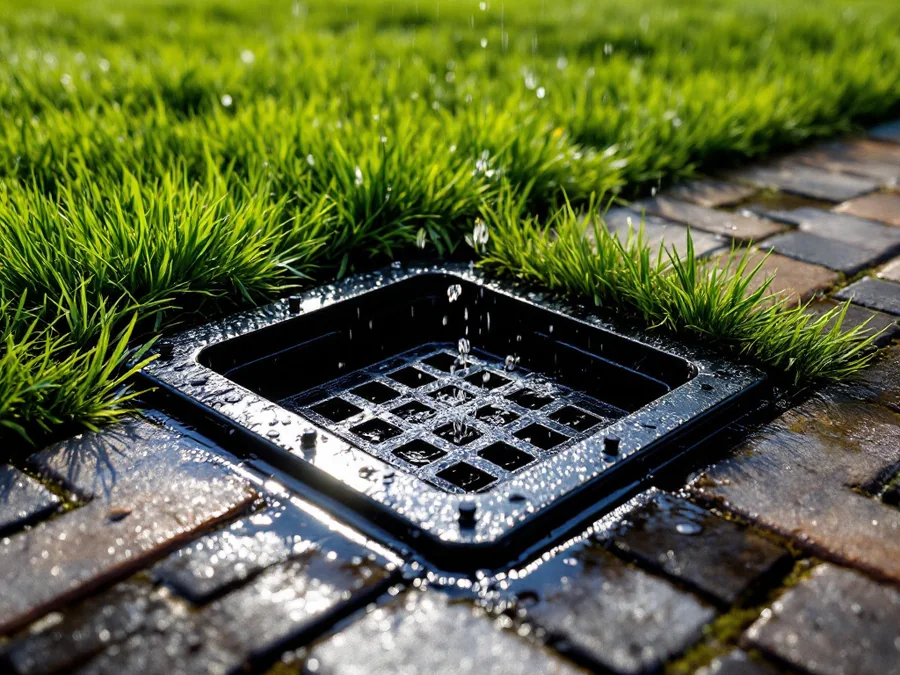
A catch basin is a box set into the ground at the lowest point of a low spot, with a grate flush with the lawn, the driveway or the deck. Surface water runs to it, drops through the grate, and a sump at the bottom of the box holds the sand and grit while the water leaves through a solid pipe to an outlet. It collects fast — a downpour arrives at the grate as a sheet and goes straight in — which is why it is the direct answer to a puddle that forms in one place every storm.
We install 9- and 12-inch NDS catch basins with grates and sumps, and the pipe from the basin is solid, not perforated, because its job is to carry the water away rather than let it soak back in nearby.
What a French drain does
A French drain is a trench lined with filter fabric, with a perforated pipe on a bed of washed gravel and gravel nearly to the surface, then sod or rock on top. Water enters along the whole length of the trench, drops into the pipe and flows to the outlet. Its strength is collecting water that is spread out or moving underground — the wet strip along a fence, the side yard between two houses, or the water that soaks through the sand, stops on the hardpan 12 to 36 inches down and runs sideways toward your foundation.
How to tell which one you need
- The water stands in one low spot — a back corner, the bottom of the driveway, the foot of the steps. That is a catch basin.
- The wet area follows a line — along a fence, a side yard, the back of the lot. That is a French drain.
- The surface dries but the lawn still squishes underfoot. That is water sitting on the hardpan, and it needs the length of a French drain to collect it.
- The water arrives as a sheet from a hard surface — a driveway, a pool deck, a patio. That is a basin, or a channel drain set into the surface.
- A downspout empties into the problem spot. Before either, pipe the downspout away. It is the cheapest fix, and on many houses the whole one.
What about a channel drain or trench drain?
A channel drain — people also call it a trench drain — is a long, narrow grated slot set into a hard surface: across a driveway apron, along the low edge of a pool deck. It does a catch basin's job, but along a line, for water running across pavers or concrete. A French drain lives in the lawn; a channel drain lives in the hardscape. Driveways and lanais get channel drains; lawns get basins or French drains.
When you want both
Many yards have a low spot and a wet strip that feeds it. The usual combination is a catch basin at the low spot with a short French drain running into it, and the downspouts on that side tied into the same solid line to the street, a swale or a dry well. The basin takes the storm surge from the surface; the drain takes the slow water from below; one pipe carries both away.
What each one costs
In our area a catch basin or channel drain runs $500 to $1,500 per point, and a catch basin plus a driveway channel drain together typically come to $1,000 to $3,000. A French drain is $20 to $45 per foot installed, so a typical 50 to 100 foot run is $2,000 to $6,000, with the sod put back. Downspout lines are $300 to $800 per point. You can add up your own yard with the French drain cost calculator.
The part both get wrong when they fail
A catch basin or a French drain is only as good as its outlet. A basin piped to the property line pushes your water onto a neighbor, which Florida's reasonable-use rule does not allow. A French drain with no low end fills to the hardpan and stops. Before we price either, we find the lowest legal exit — a pop-up emitter at the curb, a swale on your own lot, or a dry well where the water table is low enough — and mark it on the plan you sign.
Not sure which you have? Take a photo while it is raining and send it, or book a free inspection: we walk the yard within 48 hours. See catch basins & channel drains and French drain installation, or call (904) 561-1816.
Free inspection
Book your free yard inspection
Tell us where the water stands and attach a photo if you have one. We call back to set a time within 48 hours — no pressure, no sales script.
(904) 561-1816- Free yard inspection within 48 hours
- Insured · NDS-trained drainage crew
- Written price before we dig
- Mon–Sat: 7:00 AM – 7:00 PM