
Guide
Why Are My Pavers Sinking? Five Causes and the Fix
Updated October 2, 2026 · Armadillo Drainage Solutions
Free yard inspection within 48 hours · written price before we dig
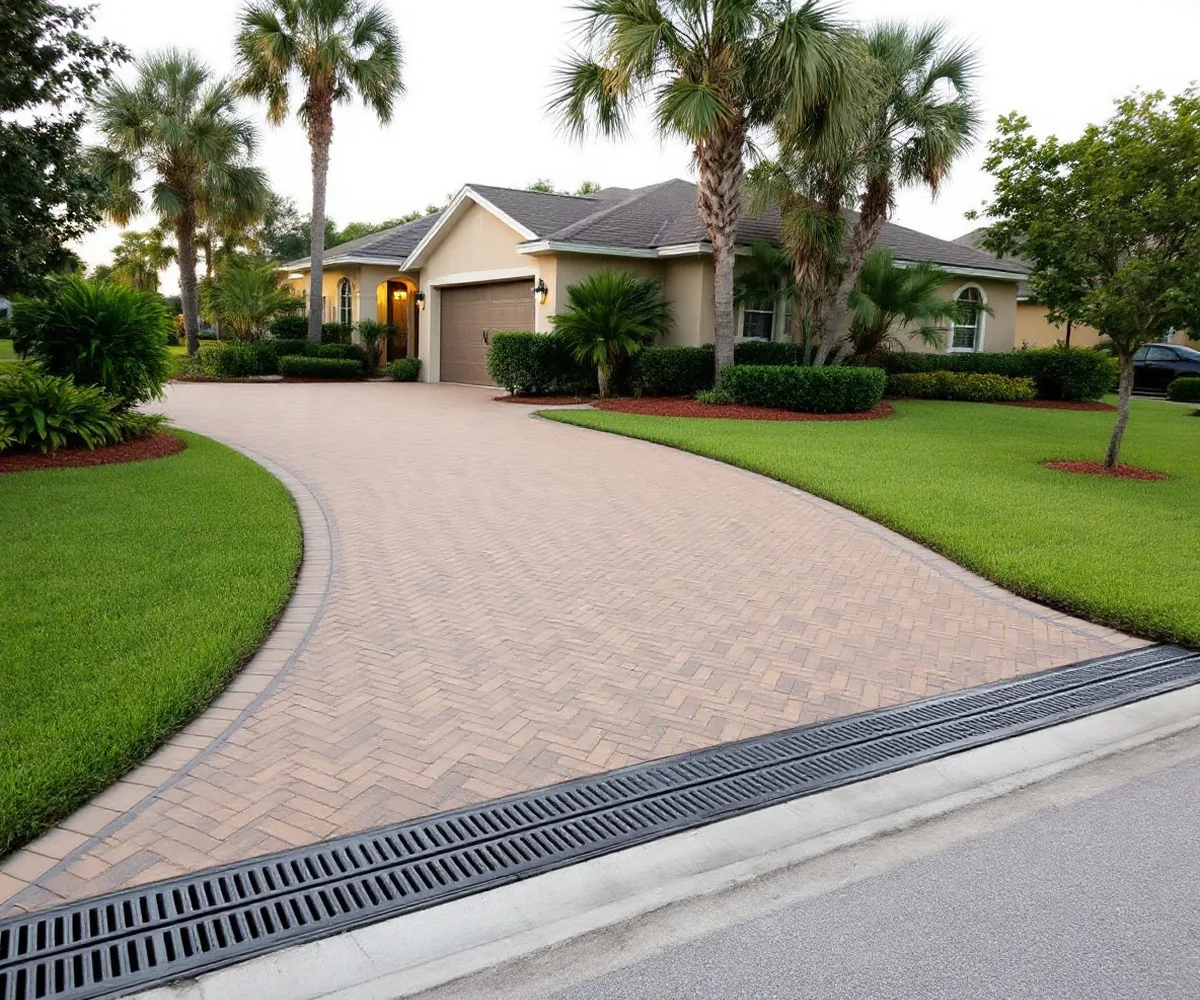
A paver surface is a field of small units resting on a compacted base, held together by sand in the joints and an edge restraint around the outside. When a section sinks, one of those parts has failed — and on a Northeast Florida lot, water is usually involved. Here are the five causes we look for, how to tell which one you have, and why relaying the pavers without fixing the cause just means doing it again.
1. A base that was not compacted
The base is the layer that carries the load. If it was placed too thin or not compacted in layers, it keeps settling under traffic, and the pavers follow it down. This shows up as a broad, shallow dip — often in the wheel paths of a driveway or the middle of a patio — within the first few years.
2. Sand washing out of the joints
The joint sand is what locks the pavers together. In a Jacksonville summer, storms that drop 2 to 4 inches at a time run across the surface and carry loose sand with them. Once the joints are empty, the pavers can rock and shift, water gets straight down into the bedding, and the section starts to move. Weeds and ants in the joints are the early warning. Polymeric sand and sealing are the prevention.
3. Water standing on the same spot
This is the most common cause on our lots. A downspout that empties onto the walk, a patio that slopes back toward the house, a pool deck that holds a puddle at one edge: water that sits on pavers soaks through the joints, softens the bedding and washes it out from below. The sand under Northeast Florida yards sits on hardpan 12 to 36 inches down, and near the river and the coast the water table can be 2 feet below the surface in summer, so that water has nowhere to go. Pavers sinking after rain, in the same place every time, point here.
4. Edges that let go
Without a sound edge restraint, the border pavers creep outward into the lawn or the bed, the joints behind them open up and the field loosens and drops. If the outer row has moved and the gaps widen toward the edge, the restraint has failed.
5. Roots and old trenches
Live oaks do the opposite of sinking — they push sections up — but they also leave low spots beside the lifted ones. And a utility or irrigation trench that was backfilled loosely under the base will settle into a narrow line years later.
How to tell which one you have
- A broad dip in the traffic path: the base.
- Loose, rocking pavers with empty joints: joint sand.
- A low spot that holds a puddle after every storm, often under a downspout or at the edge of a pool deck: water.
- The outer row has moved: the edge.
- A raised section beside a tree, or a narrow line of settlement: roots or an old trench.
How sunken pavers are fixed
The section is lifted and the pavers set aside. The base is topped up and compacted, the bedding screeded, and the same pavers relaid so the color matches, then cut at the edges, compacted and re-sanded with polymeric sand. Where the cause was water, it gets its own fix at the same time: a downspout piped underground, a slope correction, a catch basin at the low spot or a channel drain across the driveway apron or the pool deck edge. Where the whole surface has failed, new pavers on a new base are the honest answer.
What it costs
We price repairs by the section on the inspection, because the cause decides the work. For context, new pavers run $12 to $25 per square foot installed in our area, a channel drain $500 to $1,500 and a downspout line $300 to $800 per point. Cleaning, re-sanding and sealing the rest of the surface so the relaid section matches is $1.25 to $3.50 per square foot, driveways from $899.
See paver driveways & patios, paver pool decks and the paver cost calculator, or send a photo of the low spot — after a rain if you can — and we will inspect within 48 hours. (904) 561-1816.
Free inspection
Book your free yard inspection
Tell us where the water stands and attach a photo if you have one. We call back to set a time within 48 hours — no pressure, no sales script.
(904) 561-1816- Free yard inspection within 48 hours
- Insured · NDS-trained drainage crew
- Written price before we dig
- Mon–Sat: 7:00 AM – 7:00 PM