
Guide
Why Jacksonville Yards Flood: Hardpan, Water Table and Your Downspouts
Updated September 15, 2026 · Armadillo Drainage Solutions
Free yard inspection within 48 hours · written price before we dig
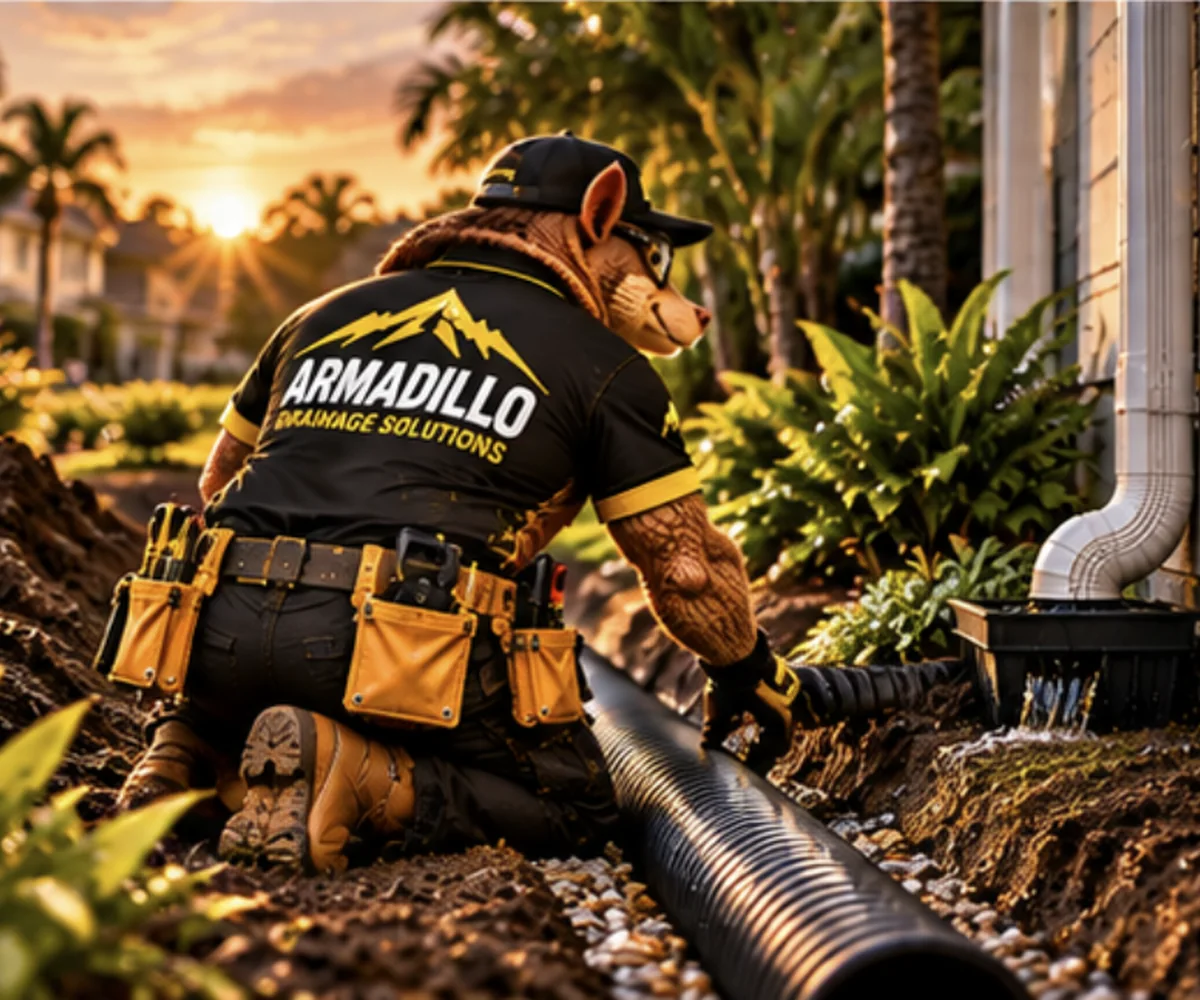
Most of the calls we take start the same way: it rained Tuesday, it is Thursday, and there is still a pond on the lawn. Jacksonville homeowners tend to blame the rain. The rain is only the trigger. Three things under and around the house decide whether water leaves or stays.
1. Hardpan: the layer your sand sits on
Northeast Florida is sandy on top, which is why people assume it drains. It does — for the first foot or so. Below that, at 12 to 36 inches, most lots hit a hardpan: a dense, dark, cemented layer (soil scientists call it a spodic horizon) that water barely passes through. Rain soaks in, reaches the hardpan and stops. Then it either sits there, saturating the sand above it until the surface turns to soup, or it moves sideways along the top of the hardpan — toward the lowest point on the lot, which is often your neighbor's yard, or yours.
This is why a yard can look dry on the surface and still squish underfoot, and why digging a small hole and filling it with gravel rarely fixes anything: the hole fills to the hardpan and stops.
2. The water table is closer than you think
Near the river and the coast, the seasonal high water table sits about 2 to 4 feet below the surface. In the wet season it rises. When the ground is already full from below, there is nowhere for a 3-inch storm to go. That is the mechanism behind the yards in Mandarin, Southside and the beaches that stay wet for a week in August: they are not draining into the ground, because the ground is already water.
3. The rain comes in bursts
Jacksonville gets roughly 52 inches of rain a year, and about half of it falls from June through September — not as drizzle, but as afternoon storms that drop 2 to 4 inches in an hour or two. A drainage system that handles a gentle rain and fails in a cloudburst is a system designed for a different state.
4. Your downspouts are pointed at the problem
Every inch of rain on a 2,000-square-foot roof is more than a thousand gallons of water. On most houses here it leaves through four to six downspouts that end in a short splash block a foot from the wall. Everything the roof collected lands in a strip of soil against the foundation — the one place you least want it. In our experience that is the single most common cause of water against the slab and the soggy bed along the side of the house, and it is also the cheapest thing to fix.
5. The lot was graded for the builder, not for you
A lot of Mandarin, Southside and St. Johns County was built on former wetland. Builders grade a lot to pass inspection on the day the sod goes down; a year or two of settling later, the swale between houses is flat and the low point has moved to the back corner. Newer subdivisions in Fruit Cove, Nocatee and Oakleaf show this within a few seasons.
What actually works
Because the ground will not take the water, the fix is to give it a route: get roof water into pipe and away from the wall, collect the low spots with a catch basin or French drain, and discharge where it is legal and harmless — the street, a swale, or a dry well sized for the storm. Which of those your yard needs depends on where the water stands and where it can go, and that is what the free inspection is for. Call (904) 561-1816 or send a photo of the puddle.
Free inspection
Book your free yard inspection
Tell us where the water stands and attach a photo if you have one. We call back to set a time within 48 hours — no pressure, no sales script.
(904) 561-1816- Free yard inspection within 48 hours
- Insured · NDS-trained drainage crew
- Written price before we dig
- Mon–Sat: 7:00 AM – 7:00 PM